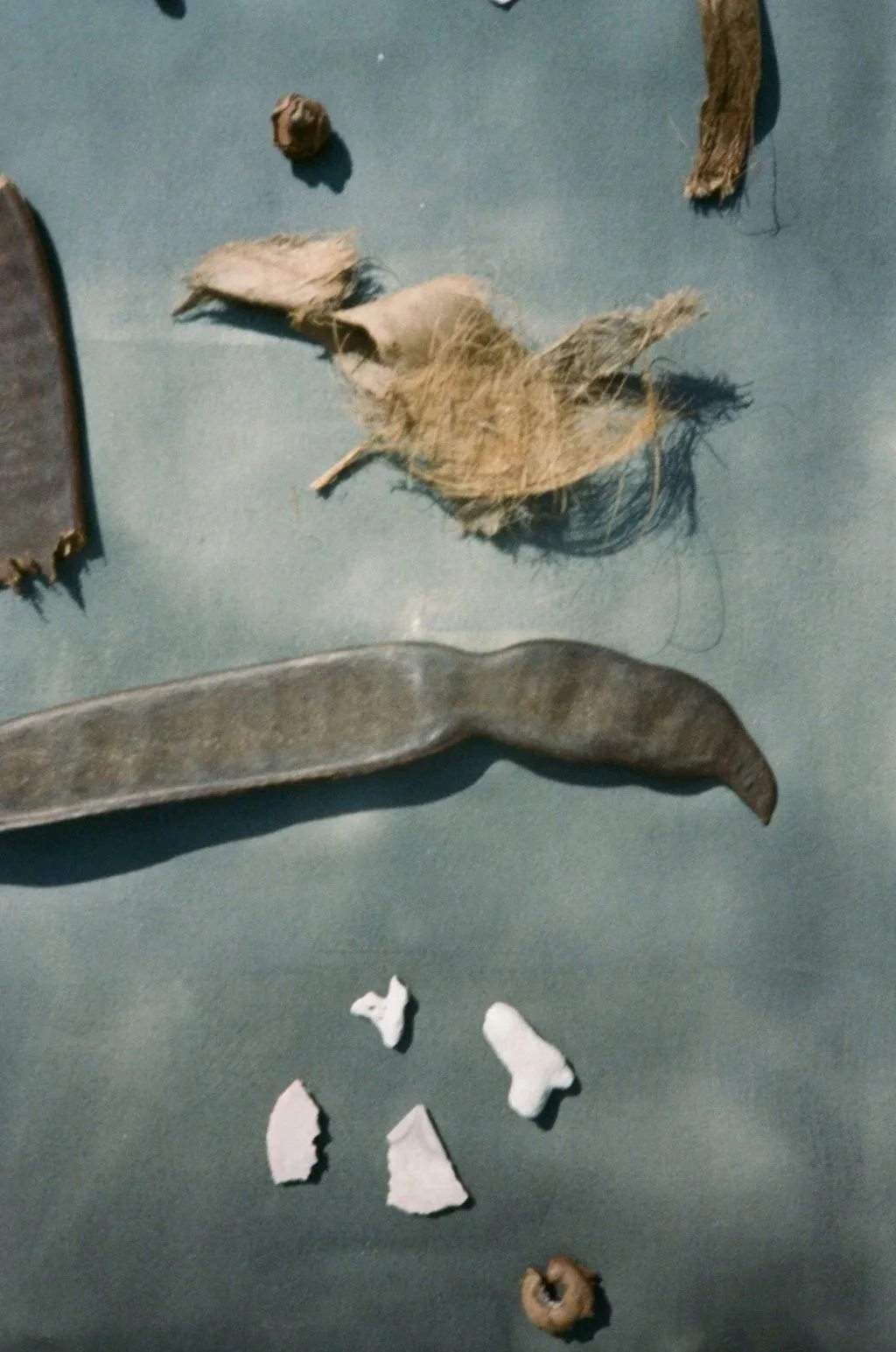
Brazilian Tropical Fibres
2023
Over the past few months in Brazil, I have been working closely with tropical fibres, observing how they are grown, gathered, and prepared across different landscapes and communities. What began as material research gradually unfolded into something more expansive: an understanding of how fibre, environment, and human practice exist within a continuous and interdependent system.
Fibres such as jute, sisal, henequen, bamboo, banana, palm, rattan, coconut coir, and aloe are often framed in terms of utility or sustainability, yet what became most apparent to me is their intelligence. Each fibre carries within it a record of its environment—humidity, rainfall, heat, and ecological density—expressed through texture, tensile behaviour, and structural variation. Everything is shaped through exposure to its landscape.
Working with these materials introduced a different register of attention. The act of preparation—drying, softening, tensioning, weaving—becomes less about asserting form and more about entering into dialogue with the material itself. Some fibres yield, others resist or fracture, while others hold unexpected strength under minimal intervention. Form, in this sense, is not imposed but gradually revealed through response.
What I found particularly resonant was the continuity between material knowledge and lived practice. Across contexts, these fibres are worked with through long familiarity—through accumulated observation and relationship. Knowledge is carried in the hand as much as in tradition, refined through repetition and sensitivity to change.
What remains with me is a deeper sense of material as a living system—one that remembers, responds, and negotiates. To work with it requires restraint, attentiveness, and a willingness to allow structure to emerge through relationship rather than control.