
Janine Saul
Textile Artist
1997
Artist Bio
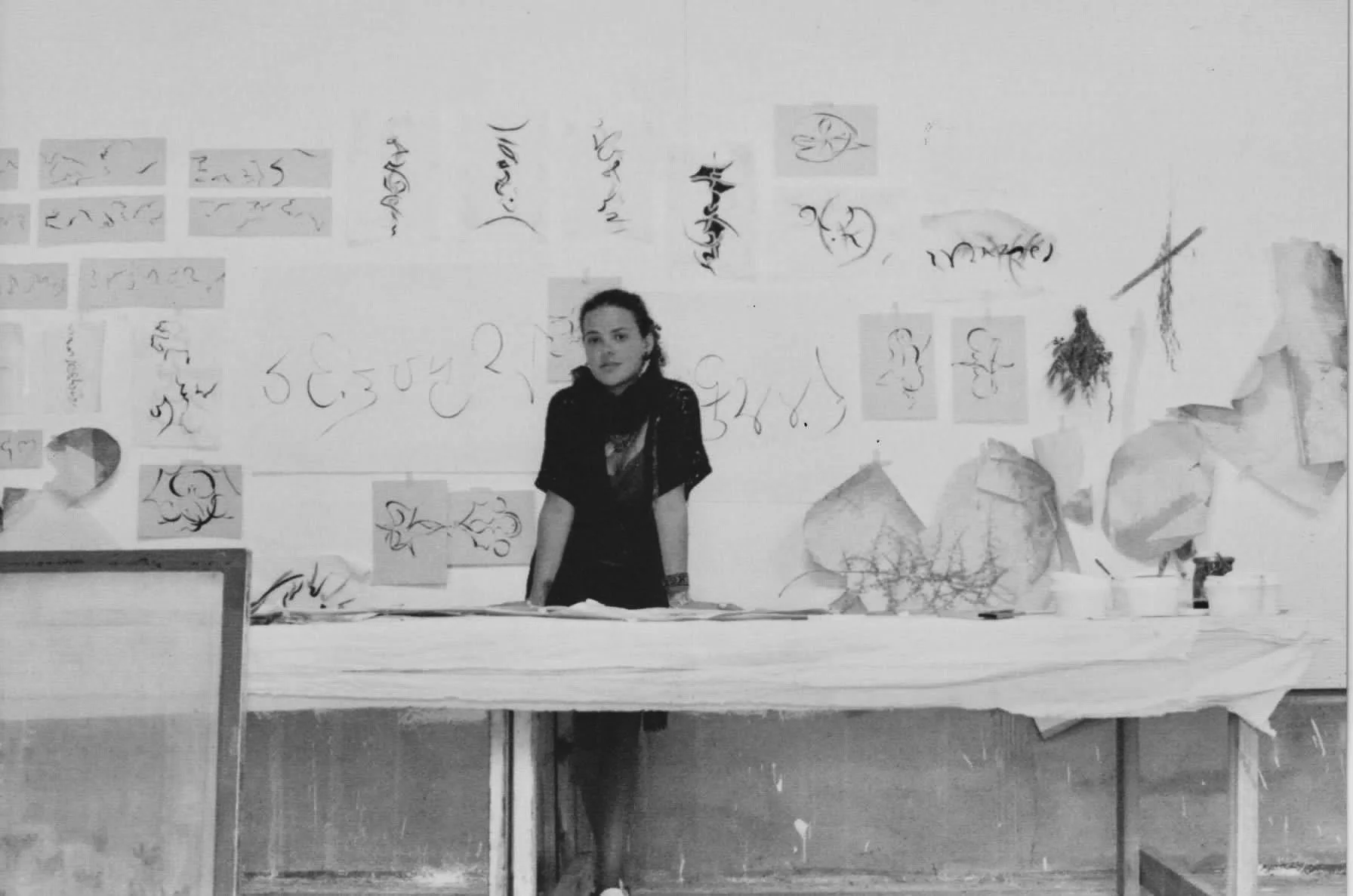
Janine Saul London based textile printmaker, exploring perceptual thresholds through sustained attention to process and material. Her practice incorporates textile knowledge from both contemporary and ancestral traditions, including field-research in Peru, India, and Japan. She earned a BA with distinction in Textile Design from Chelsea College of Arts at the University of the Arts London in 2019. She completed a six- month exchange at the Fashion Institute of Technology in New York in 2017.
Her first solo exhibition, She Transient Dance, was at Villa Lena in 2022. She has also installed her work in remote landscapes, including Spirits of the Water in the Palenque jungle, Mexico (2021), and La Madre Amazonas in the Bolivian Amazon (2024). Her work has been in group exhibitions such as Future Stars at The Holy Art Gallery, Athens and London (2023) and The Other Art Fair, London (2024).
Saul has completed residencies at Ohara- Kobo, Kyoto, and Villa Lena, Tuscany. Saatchi Art named her one of its Rising Stars in 2024.
CV
-
2016 - 2019
Textile Design BA, Chelsea College of Arts, University of the Arts London
First Class Hons
2017
Exchange Program, Fashion Institute of Technology, New York
GPA 5.0
2015 - 2016
Art Foundation, Camberwell College, University of the Arts London
Distinction
-
2022
She Transient Dance, Villa Lena Rain Room, Tuscany, Italy
2021
Spirits of The Water, Jungle Installation, Palenque, Mexico
Impermanence of the Physical, Hackney Bridge, London, UK
-
2024
The Other Art Fair, The Truman Brewery, London, UK
2023
Future Stars, Holy Art Gallery, London, UK
Future Stars (Virtual), Holy Art Gallery, Athens, Greece
2022
Spirits of The Water, in collaboration with La Presencia, Oaxaca, Mexico
2021
Facade, Holy Art Gallery, London, UK
In The Wild, King House Gallery, London, UK
2019
Play, Nike Headquarters, Portland, Oregon, USA
Summer Exhibition, Chelsea College of Arts, London, UK
2018
Light Pressure, Exhibited at Premier Vision Paris, France
2017
Falling Seasons, Fashion Institute of Technology, New York, USA
-
2022
Villa Lena Artist in Residency, Tuscany, Italy
Marciaso, self-directed Artist in Residency, Apuan Alps, Italy
2018
Oharah-Kobu, Artist in Residency, Kyoto, Japan
-
2021
Shortlisted for Emerging Artist of the Year, The Artist Lounge, Wells Art Contemporary, London, UK
2018
TED 10 Sustainability Design Principles, TED, London, UK
-
2024
Private Art Tutor, Online, London, UK
2021
Guest Lecturer, University of the Arts London, UK
Private Workshop Facilitator, IntoArt, LAB E20 & Copeland Gallery, London, UK
Print Workshop Coordinator, 3rd Rail Print Space, London, UK
Triptych, Curated Collective of Art Practitioners, intermediate schools in London, UK
2020
Technical Print 1:1 Atelier Associate for luxury brands, 3rd Rail Print Space, London, UK
2019
Life Drawing Classes, Intermediate schools in London, UK
-
2025
Rebecca Wilson, Rising Stars: Emerging Artist to Collect Now, Saatchi Art
2024
Micheal Hanna, AFA Artists Feature Catalogue and Critical Review, Point Pleasant Publishing
2023
Gunther Michels, Moving Creativity through Screen Printing and Abstract Textile Painting, Vagabundler Interview
2022
Poppy Barnes, A Symbiotic Dance between Boundaries and the Boundless, Between the Art Blog Interview
Bre Graham, Villa Lena: a creative retreat in the heart of Tuscany, Courier Magazine Interview
-
2025
Sri Vraja Kishori Seva, Vrindavan, India
Offering Tradition and Textiles, Yamuna & Gangotri, Himalayas, India
Natural Pigments Project, Hind dyes, Jaipur, India
2024
Natural Pigments Project, Amazon, Rurrenabaque, Bolivia
Pigments and Purpose, Quechua Ausangate, Andes Mountain Range, Peru
Art in Tradition, Wilka Community, Sacred Valley, Peru
2023
The Eternal Rose, Marciaso, Apuan Alps, Italy.
Objective Vision, Wilka Community, Sacred Valley, Peru.
Art and Elder Wisdom, Valle De Los Cóndores, Tarija, Bolivia.
Weaving Tropical Fibres, Interior Spatial Design. Rio De Janeiro, Brazil.
Learning the Land, Mocoa, Columbia
2022
Resin Research, Medicinal Properties, Taurus Mountain Range, Turkey
Natural Material Building, Bring the Noise, Pontoise, France
Wisdom from the Elders, Tribe of Wirrarikas, Potosi, Mexico
2021
Mothership Campaign, Climate Conscious Movement, Wye Valley, Wales
2020
Kinetic Installation Set, Bingo Fury, London, UK
Textile Set Installation, Bananrama, London, UK
2019
Sustainability for Zara Kids, Zara Kids. Spain.
2018
Learning from Light, Naoshima, Japan
Indigo Dye Elder, Master Mr Hiroykui Shindo, Kyoto, Japan.
Artist Statement
Layering, for me, is a central method, allowing the past and present to coexist in a process that conceals and reveals in turns. I use it to create spaces where uncertainty is held long enough to shape form and structure. I understand time as something to be held rather than hurried, and experiences as something to be carried rather than erased. My work honours slowness, visible process, and the whispered authority of marks shaped through living. What begins as a personal engagement with material, through sustained attention, becomes a threshold of perceptual clarity. Inviting the viewer to encounter a subtle alignment between their internal response and material presence.
My work draws from hands-on research in Japan, Peru, and India. This taught me to develop natural pigments that I use to reflect memory, patience, and natural processes. I combine these dyeing practices with self-developed screen-printing techniques, moving between bold gestures and delicate details. Silk, paper, and pigment interact through tactile processes, registering pressure, impression, and repetition. The material resists and responds, producing friction that shapes each mark. Texture accumulates through these encounters, catching light and holding the traces of heat, water, and wind.
I activate each technique to invite perceptual awareness, rather than interpretation, using process and material to direct attention. Subtle shifts in surface, colour, and texture require viewers to slow down. As attention deepens, I want the boundary between the observer and the observed to soften. I aim to create a space where the viewer becomes fully present in the unfolding unknown.
My work is a constant negotiation with the limitations of language. As a child, I wrote naturally from back to front - writing that was only legible in the reflection of a mirror. My mind has always processed the world in reverse. I use printmaking on textiles to translate my thoughts to others because it is a process structured through reversal, where meaning appears through reflection. In a world accelerating toward certainty, I use this process to slow down and make space for deliberate uncertainty. My prints inhabit this disorientation as a perceptual threshold to explore, rather than a deficit to endure.
My practice unfolds in respect for historical textile traditions, honouring them as living knowledge and working with their material intelligence with care in the present. Textiles have an enduring capacity to carry memory, meaning, and perceptual resonance through fibre, stain, and touch. In working with them, what begins as a personal introspection opens into shared perception: contradiction remains, but it no longer disrupts. It gathers. It steadies, it connects. Coherence appears through presence rather than resolution.
Through texture, layering, and abstraction in the screen-printing process, I engage tensions between the screen and fabric. This tension activates a threshold between control and intuition, movement and isolation, and surface and depth. These oppositions remain active, held in suspension, allowing tensions to unfold between the surface and the screen until they begin to gather into coherence.