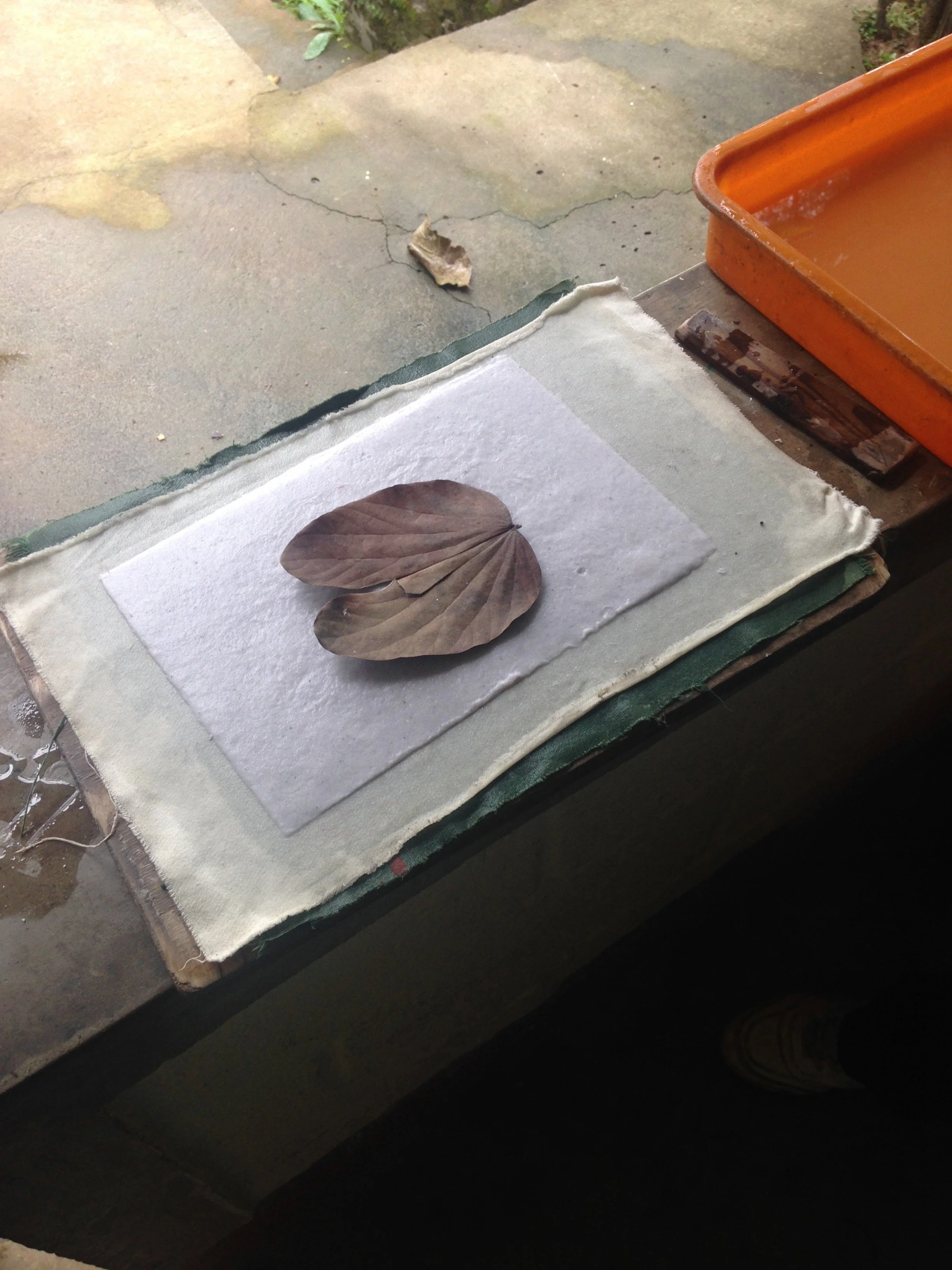
Indian Paper Making and Embossing
2021
During my time in India, I became deeply interested in natural paper making through learning directly from a local maker whose practice approached material with extraordinary patience and attentiveness.
What drew me in immediately was the philosophy underlying the process: the understanding that materials are never fixed, and that even discarded fibres can be broken down, transformed, and given new form through care, pressure, water, and time.
Paper, in this context, no longer felt like a passive surface. It became a living material—capable of holding memory, texture, density, and atmosphere within its structure. Scrap fibres, cloth remnants, and reused papers are dissolved into pulp before gradually reforming into entirely new surfaces. Watching this transformation shifted the way I thought about material itself: dissolution becoming reconstruction, fragmentation becoming cohesion.
What continues to resonate with me is the balance between control and surrender embedded within the process. Fibre distribution, water content, drying conditions, and pressure all shape the final surface unpredictably. No sheet forms identically. Irregularities, variations, and imperfections become part of the material’s character rather than flaws to erase.
Embossing deepened this understanding further. Through pressure alone, surfaces begin to hold structure, rhythm, and subtle relief without the need for excess intervention. Form emerges through indentation and absence as much as through addition.
This philosophy has deeply informed my textile and printmaking practice. I’ve become increasingly interested in how natural materials can be transformed into entirely new surfaces and languages of expression—allowing process, texture, and material behaviour to guide the work itself.
What remains most compelling is the intelligence held within these handmade surfaces: their ability to carry time, touch, and transformation within every fibre.