Natural Materials Printmaking
2022
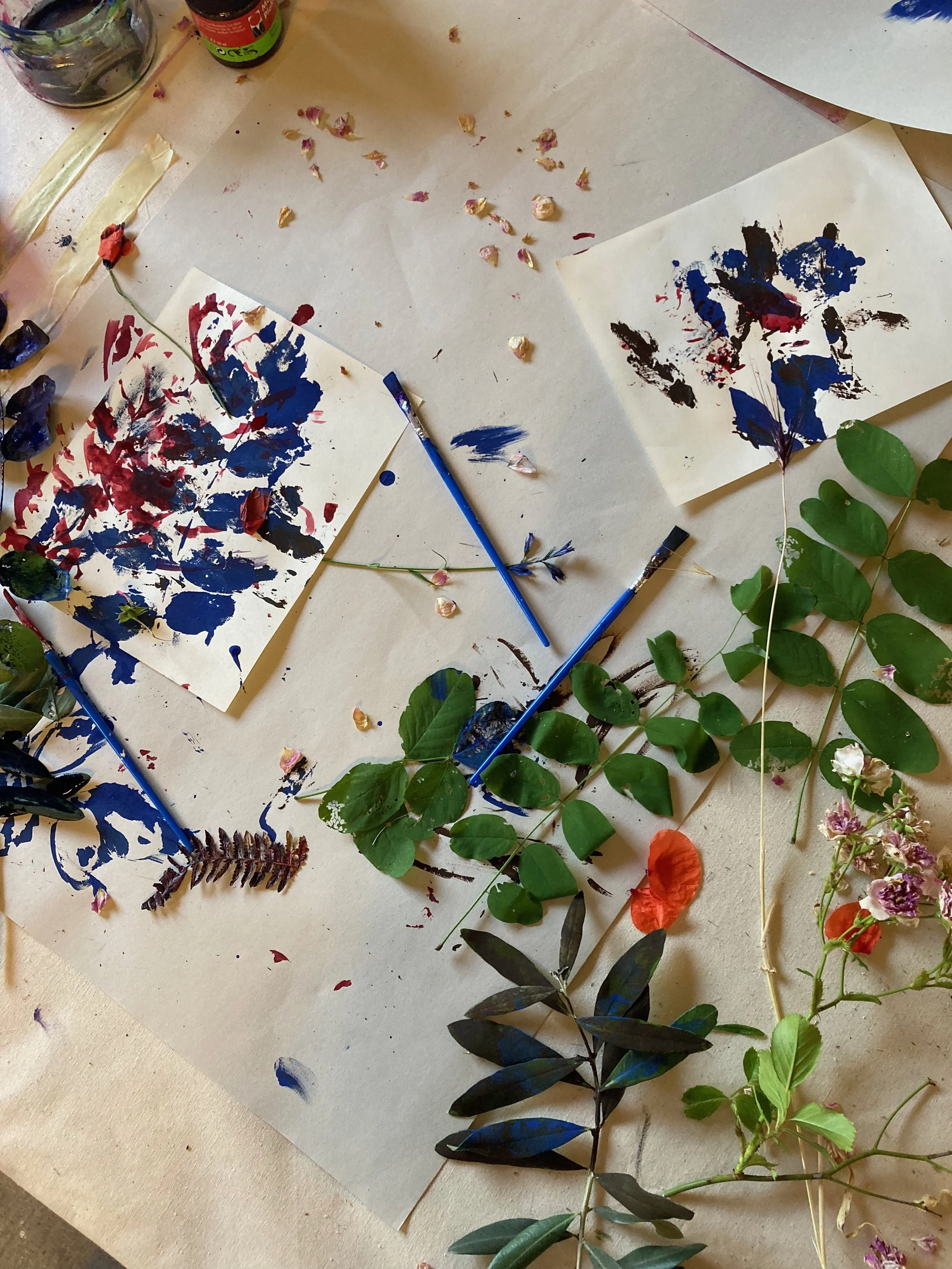
Printmaking with natural materials in a series of workshops I led in Tuscany has gradually become a way for me to work more directly with environment, allowing the landscape itself to enter the textile process.
Rather than relying solely on conventional tools and controlled surfaces, I’ve become increasingly interested in using plants, fibres, flowers, bark, grasses, and found natural elements as active components within the print itself—creating resists, textures, interruptions, and layered impressions that could not be predetermined.
Working this way shifts the relationship between maker and material. The process becomes less about imposing an image and more about responding to what is already present within the environment.
Materials gathered from the landscape carry their own structure, density, fragility, and rhythm. Fine grasses leave delicate linear traces across silk; thicker leaves interrupt pigment flow with heavier forms; unstable materials collapse, stain, or shift unexpectedly through pressure and movement.
Within the printmaking process, these elements are positioned between screen and surface, allowing pigment to move selectively across the textile. Layers accumulate gradually through blocking, reprinting, inversion, relief techniques, and repeated interventions. Positive and negative space begin to evolve organically, guided as much by the behaviour of the material as by intention itself.
What continues to resonate with me is the philosophy underlying this way of working: adapting to what is given rather than forcing uniformity onto the process. The landscape becomes collaborator rather than backdrop.
Over time, I’ve come to understand these natural materials as carrying their own intelligence and memory. Their textures, imperfections, and responses remain visible within the textile surface, allowing each print to hold a direct record of interaction between environment, material, gesture, and time.