India Natural Dye
I spent four months in India, working across Rajasthan and the upper Himalayas to deepen my understanding of natural dye and material process. This period of study extended beyond technique. With familial ties to the region, it became a return as much as an inquiry—into colour, labour, and the conditions through which material knowledge is carried.
India holds a long and continuous history of natural pigment practice. Indigo, derived from Indigofera tinctoria, is among the most culturally and materially significant, valued for its depth and durability. Alongside this, madder root yields reds and pinks, turmeric and pomegranate produce yellows, while layered processes with iron or indigo shift tones into greens and deeper registers. These pigments are not fixed substances but responsive systems, altered through water, temperature, mineral content, and time.
Working primarily on silk, I focused on indigo alongside a spectrum of pink, orange, yellow, and green. The dyes were prepared through traditional methods: plant matter reduced through sustained boiling, pigments released gradually into water, then filtered and reworked through repeated immersion. The process resists immediacy. Colour emerges through accumulation—each layer holding variation, each decision altering the next.
This approach directly informs my practice of contemporary printmaking with natural pigments on silk. My work operates through printmaking exploring perception and reversal, where pigment is transferred, resisted, and reabsorbed by the silk surface. The fabric is not passive; it receives, diffuses, and holds memory. This creates a form of process-led textile art exploring uncertainty, where outcomes remain partially indeterminate.
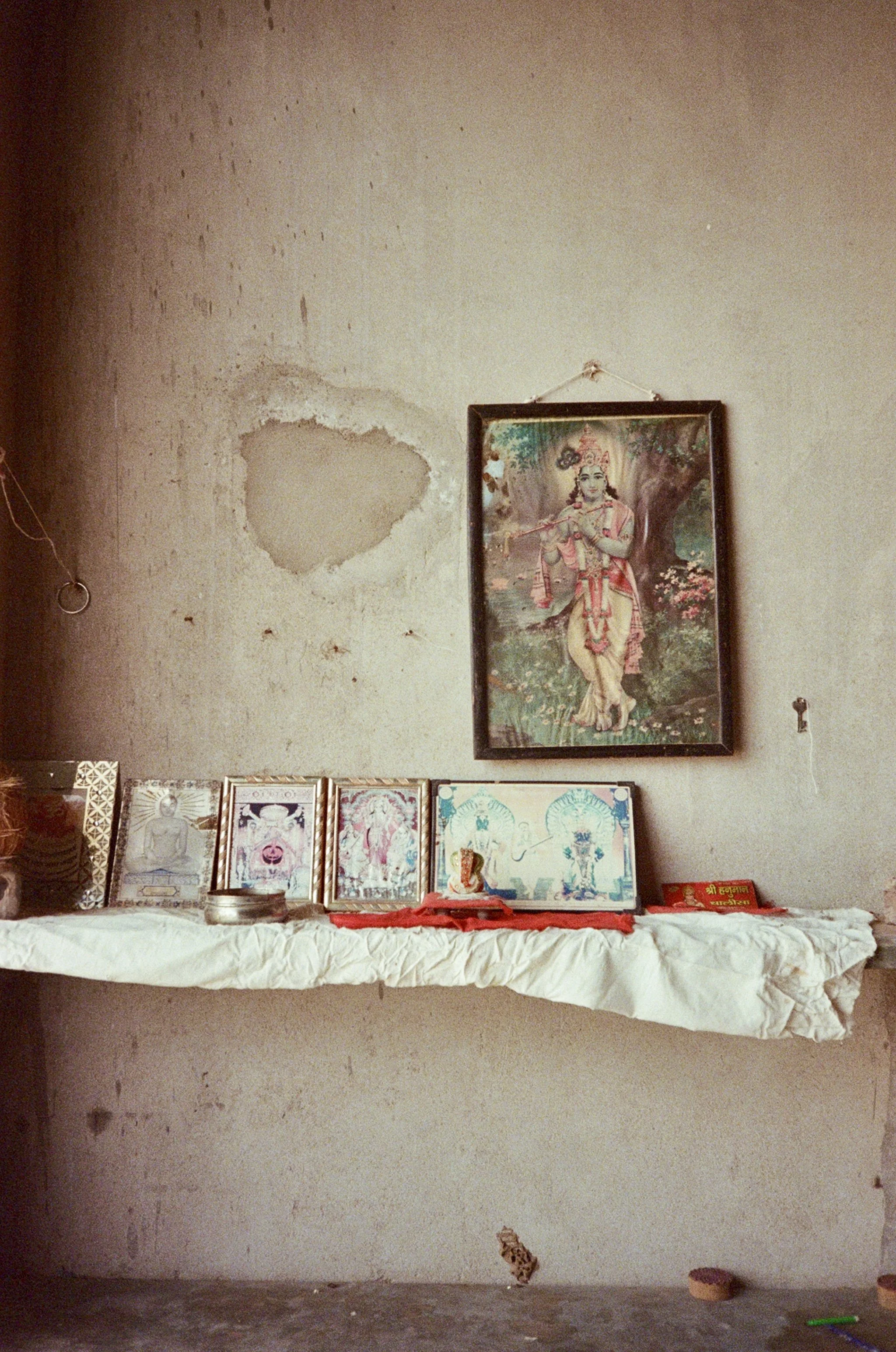
Equally significant was the cultural framework within which the work took place. The preparation of dye was treated as a form of ceremony. Silk and pigment were offered before use, placed at an altar in acknowledgement of their origin. Shoes were removed; spaces were kept with the attention of a temple. Conduct, conversation, and dress were considered part of the process. This was not symbolic but structural—an understanding that material carries presence, and that working with it requires a corresponding awareness.
This alignment has become central to my methodology. Through material-led abstraction through layering and time, I engage with thresholds between control and release, saturation and absence. The resulting works sit within perceptual abstraction in contemporary textile art, where colour is held in tension—neither fixed nor fully resolved.
What remains from this period is not only a palette, but a discipline of attention. A recognition that colour, like memory, is built slowly, and that its depth depends on the conditions in which it is allowed to form.